
3-1 | Table of Contents | http://dx.doi.org/10.17742/IMAGE.stealimage.3-1.3 | Ury Desmarais PDF | To Portfolio
Tanya Ury | Claude Desmarais
Interview
Q: Fading into the Foreground depicts the everyday wear of camouflage; does this represent to you a decontextualization of war and violence? You spoke of your shock and horror witnessing the display of nationalism at the 2006 World Cup quarterfinal between Germany and Argentina, where fans were draped in the flag and singing the German national anthem. How did this affect you and the work you had just begun? What are your thoughts on German nationalism in our present age? How does this decontextualized use of camouflage influence movements like “Occupy”?
A: It’s a long haul since the Beatles paraded colourful, military-style jackets, emulating a past Victorian and colonial era in 1967, on their Sgt. Pepper’s Lonely Hearts Club Band record cover. Was the clothing worn in protest to the Vietnam War? Or was it some sort of glorification of the military? What will this statement have been telling the thirty-two million purchasers of the album? “We won the war,” the phrase referring to the Second World War on fascism in Germany, was still being spoken on British lips, after the World Cup Final in 1966, when Great Britain won against Germany. The war was still being fought in fields of popular culture. I was a teenager at the time and can remember that it was fashionable to carry paper shopping bags flaunting the British flag. The military look and nationalism have, hand in hand, remained evergreen in fashion, but it is difficult to tell when this has been about parody.
Andy Warhol created many camouflage prints in 1987. In 2005, DPM (Disruptive Pattern Material) was published by Maharishi in London. It is a large, two-book, bound edition on camouflage patterns of the world, which was about army uniform and weaponry concealment design, but also fashion and art that made use of the camouflage motif. It seems that the military fashion hasn’t waned completely, although the heyday of a few years ago, when it was seen represented by high fashion companies and on magazine covers, is past.
Army surplus, on the other hand, is an inexpensive way to dress and what’s more, lends the wearer a look that suggests power and standing. I have photographed such clothing being worn on the streets internationally for the ongoing Fading into the Foreground series and it is often the marginalised, road workers, who wear camouflage, not as a fashion statement, but because it is durable and cheap to purchase. In each situation, the symbolic gesture of the dress code is about masquerade.
In some situations, when I have captured the moment on photographic film, the symbolism appears to be loaded. During the FIFA World Cup being held in Germany of 2006, (in which Germany finished third) for the first time, a new generation of Germans allowed themselves the celebration of nationalism (draped in the veil of patriotism) that was previously considered to be in bad taste. It was, in fact, the display of flags seen in Germany on such an overwhelming scale at the time that prompted me to start the photographic series. So many people were waving flags and some of these were simultaneously wearing camouflage—it certainly caused me to question this incongruous display. I have lived in Germany for over twenty years, and when I came here, I respected Germany’s vigorous attempt to process and account for its National Socialist past. And then suddenly what had been absolutely taboo the day before, I mean the flaunting of the German flag, was being relished with relief the following day, on all German streets. I could understand a German need for a sense of pride, but I cannot relate to nationalism of any sort.
A previous blow had been when Joschka Fischer of the Green Party announced that the German army would again be seen in action, even if primarily, merely as observers in Kosovo. The Green Party, which had made it to coalition rule in 1998 (Joschka Fischer became Vice Chancellor and Foreign Minister of Germany), emerged in late 1970s Germany with a policy of pacifism (negotiation through peaceful discussion was to be attempted in preference to aggressive military action); it was clear that the peacekeeping role in Kosovo would become a slippery slope (which eventually led to real action supporting NATO manoeuvres in Kosovo and later Afghanistan in 2001).
I have taken over 1,600 photos for Fading into the Foreground (most of which, still have to be sorted). The most recent were made in Strasbourg at the Occupy demonstration in front of General Kléber’s memorial in the central square, on 15th October 2011. In my experience, there will always be someone found in any crowd sporting camouflage fatigues (either civilians or army members on leave); in the context of Occupy, the wear attains its own particular symbolism. With the display of camouflage, the civilian possibly betrays a desire to immerse her/himself in an unregimented army of the masses that by taking to the streets, to a demonstration, expresses people power, an as yet unharnessed vox populi.
Q: In 2009 you were part of Art of Emergency, an exhibition with the mandate of “artists who care about the mutual tragedy of people in the Middle East.” How does this mandate inform or misinform people about your art? Are there still lasting effects upon your present work, or is your present work still informed in a meaningful way by that period of your life?
A: For Art of Emergency,I presented a photograph of my two nieces, who live in London. Sibling Rivalry depicts Elà on the left wearing a Kefiya (Arab) scarf and the younger Leylà on the right, wears a Star of David round her neck; their parents are Jewish and Turkish (Deniz, their mother is a non-practising Muslim). I feel that this image represents well the conflict still raging in Palestine, which might nevertheless be resolved if Israelis start to recognise the Palestinians as brothers and sisters living on the same plot of land, and who should be respected and granted equal rights as citizens.
In the Emergency Room exhibition of 2006, also in Berlin, I presented sixteen photos from the Fading into the Foreground series of people wearing camouflage, on Cologne streets in Germany but also on the streets of Jerusalem. In Israel, the significance was compounded because it was a war zone—the authentic members of the military seen there in uniform were on active duty; since more or less every citizen will have been a member of the army at some time in her/his life however, the distinctions were unclear—the casual wearers of camouflage on the street will also have actively been soldiers at some time, unless they were merely a tourist.
Germans have always spoken to me, as though I, a Diaspora Jew from England, was somehow responsible for the afflictions of Palestinians, under Israeli mandate in Palestine. My artist’s scrutiny had been directed in the main to how Germany has dealt with its fascist past. More recently it has, however, become clear to me that as a Jewish person, I do have a responsibility to at least voice my disagreement with the aggressive and unfair Israeli policies towards the Palestinian people, as publicly as possible. Activism can take several forms—I have made several more art works on these issues but importantly, am affiliated with activist groups in Great Britain and in Germany: JfJfP (Jews for Justice for Palestinians) and the Jüdische Stimme für gerechten Frieden in Nahost, EJJP Deutschland (Jewish Voice for a Just Peace in the Middle East)—as a group, our voice has a far more vigorous effect in public discourse.
Q: Identity and nationality are key themes in part of your work. You have been identified as an English-Jewish and German-Jewish artist. Do these titles or descriptions hold power for or over you? In postcolonial theory and discussions of globalization, hyphenated identity is a key term for understanding the modern or postmodern experience. In keeping with such discussions, does one identity hold sway over the other for you, or how would you describe the amalgam of identities that we all, hyphenated or not, carry within us?
A: I find it not possible to be an escapist artist. And like anybody, I get called all sorts of names; the legacies (British, German, Jewish, female, older), accepted at least in part, can be deployed usefully as tools, when reflected back to a general spectatorship, as images of cliché, to demonstrate and underscore stereotypical thinking.
Q: Some of your latest work, including the photographic collection of Soul Brothers & Sisters depicts artists, activists, and musicians sporting a shirt with your modified Hugo Boss logo. The models seem to deconstruct the conventional fashion magazines’ advertisements; having them photographed in different locations in the world gives the work a global feel. Was this your goal? It reads like a public service piece of art, informing people of the troubled heritage of a massive clothing designer. How do people react to the news that Hugo Boss produced uniforms for the National-Socialists? Does the reaction change when they learn that the 2008/9 Hugo Boss collection revisited the past; for example, one full-length leather coat seemed to parody the German Luftwaffe uniform from the National-Socialist period? Is this collection another extension of your shift into works about and on the body, using the model’s bodies to display your art?
A: I started with the multi-media series Who’s Boss, 10 years ago. In conversation, it still often occurs that people do not know of the connection between the contemporary Hugo Boss Company and Hugo Ferdinand Boss’s original company, which produced Nazi uniforms in Germany, prior to and during WW2. I wanted to inform the public and had plenty of examples to choose from. Within the extensive bounds of post-war German industry or from leaders in senior executive positions, the German heritage may be seen as the seamless continuation of a culture based on exploitation. And industry continues to gain in global power. This is the certainly case with the Hugo Boss Company, an international company.
I have had the good fortune to be able to travel, and when I do, I take my work with me. Photographing other people in the Soul Brothers and Sisters series (wearing T-shirts with the subverted Boss logo, altered to include the SS rune) was also an extension of my artistic practice, so often expressed by my own body. The T-shirt, yet another kind of uniform, worn to protect or merely disguise the body, may become disruptive; when it is also seen to be making a statement, it becomes more than merely a fashion item. And it is great being part of a chorus; too often one stands alone as an artist.
Q: dark room is a very personal, reflective multimedia piece done after your fight with cancer. How does this piece reflect the personal journey you undertook surviving your bout with the disease? Do you see your body—and to a larger extent, the entire physical body—any differently now?
A: The recording for the installation dark room is of all sound reduced to ambient atmosphere, around and including the body. You hear breathing and sounds in the room, over a prolonged time. But dark room is as much about meditation as anything. In meditation, one goes within the body to the centre of life energy. I started with the practice of Guru Maharaji’s meditation in 1973. During the discovery and immediate treatment for breast cancer in 2010, meditation became an even more profound experience for me. I was able to keep centred on a point of joy and relaxation, when my outside world seemed to be falling apart. dark room is the absolute reduction of an art work which suggests more however, the sound of breathing and the title, point to activities in a sex club. Everybody’s reaction to illness is individual. In my case and in spite of my age, it has been towards the celebration of the somatic, as well as the spiritual. If my reflections on the body have altered at all, it is to focus on life and not on illness or infirmity.
Q: The historical photograph in your work Alibijude likewise uses the personal as a starting point, as the photographs feature your great-grandparents as well as your grandparents. How do you feel about having an ancestor that the National-Socialists profited from?
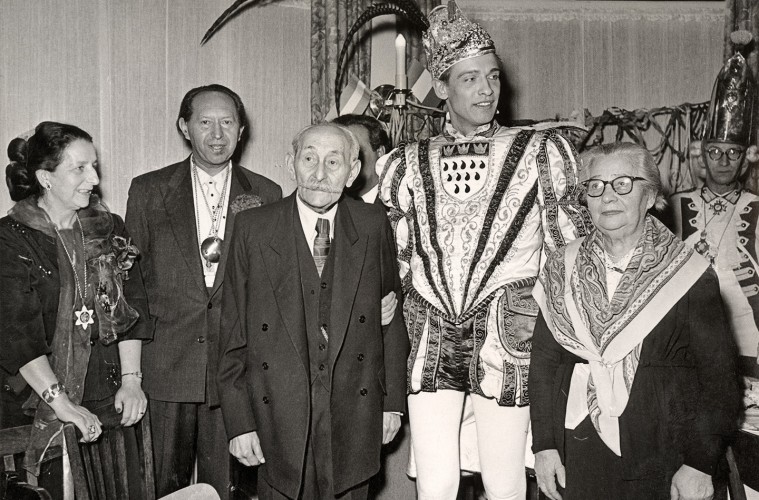
A: In January this year (2012), my aunt Annette Pringle (née Felske) came over from the USA, after the death of her brother Gerd. They were both born before the war. She told me that she had found a copy of the very same photograph that I recently adopted to make an artwork of, amongst her brother’s possessions, but was surprised at my interpretation of the image; living in Boston, Annette had not yet heard of the Neven DuMont scandal some six years ago. In 2006, it had emerged that Kurt Neven DuMont, who ran the Cologne daily Kölnische Zeitung before and until shortly after the end of the war, had Aryanised several houses, property belonging to Jewish people forced to sell well below value; this fact had been kept under covers by the DuMont family.
I entitled the press photo of my family in 1955, Alibijude (Alibi Jew); it reveals my grandparents and great-grandparents, survivors of Theresienstadt, being embraced by a young Alfred Neven DuMont, son and heir of the previous newspaper magnate; his paper was later renamed the Kölner Stadt-Anzeiger. My great uncle Wilhelm, who wrote a Stadtanzeiger feuilleton for the rest of his working life, was also present at the scene. With the text I wrote to accompany the artwork, I expressed my ambiguous feelings regarding the family connection with the DuMonts—my grandfather Alfred together with Wilhelm had organised a new newspaper license for the DuMonts, from the American authorities, after the war.
In a conversation with Annette when she was here in January, she informed me that the Neven DuMonts had done much to assist family members who were in hiding in Cologne, during the war, something that I had not been aware of. So I must again review this complex, symbiotic relationship.
Q: In some ways similar to Alibijude, the video Intimacy uses footage of yourself and another person. How do you see the interstices between the personal and art in this piece? Is there a reason that much of your work includes the personal? For instance, do you have the feeling that parsing or leaving out the personal is dishonest or is it a barrier to artistic achievement? Or does it have to do with honesty about the source of your inspiration?
A: There is the case of Maxim Biller’s novel Esra, which was banned shortly after its publication in 2003, after members of the family of a former lover he had described in the book (too closely for their comfort) sued for defamation. It was beyond my comprehension how courts in Germany could propagate this kind of censorship, when doubtless all literature is based on personal experience. How distanced from reality must literature be before its source becomes unrecognisable? This risk-free publishing culture, to my mind, evokes a time not so long ago when what the authorities considered to be degenerate literature was delegated to the bonfire.
With Intimacy, as with much of my self-portraiture, I decided to cut corners and use source material: personal footage from 1991 of the sexual act with a lover on video, but accompanied by very honest, literary texts, describing the carnal in human relationships (I employed quotations from Intimacy by Jean-Paul Sartre and Intimacy by Hanif Kureishi). The contrast between image and text, visual representations of the cerebral and the physical, leaves the viewer questioning which trajectory to follow—it is impossible to follow both, at the same time.
Q: You state that you have created most of your work in English and German. Words and names carry so much weight and power. How important is it to you to have your work interpreted in these two languages? Have you ever made, or felt the need to make a linguistic nod to your Jewish heritage, say through the use of Yiddish?
A: German was the language that I first heard as a child. My parents and grandparents were German. I learned German alongside English in Great Britain in the early fifties. When visiting the family in Cologne as a child, a few Yiddish words may have fallen, but these will have been picked up from elsewhere. It was not our means of communication. My heritage, like klezmer music, is not folkloristic (my father was a composer; my grandfather was a writer, both in the classical tradition).
I find language, whether visual or written, a battleground; it doesn’t come easy living in parallel universes, trapped between image and text, or the different meanings implied in the two languages; but the fact that I work so much with wordplay, an essential part of Kabbalist practice, is a nod to a Jewish heritage.
Q: Throughout your career, you have been invited to give talks and presentations around the world. In our global age, how has globalization affected your work?
A: It has been by means of e-mail and the Internet that I have often been informed of and been able to apply to conferences internationally. Networking has certainly become a very important aspect of artistic life. The same prejudices still apply in a market-oriented art (and literary) world: sexism, ageism, racism and political prejudice—even amongst activists there are fashionable and unfashionable causes, fighting for attention. I have experienced discrimination to the left and to the right. With the Internet, one has a greater than ever means to connect on a democratic basis; websites, like messages in virtual space bottles, occasionally get discovered by others, with similar objectives.
I write and make art now with wider horizons in mind. Eight years ago I decided, rather than investing effort in publishing art catalogues, I would produce a website that should be constantly maintained and updated. For someone like me, working on the outer edge of non-conformity, this publicity tool has been vital in the fight against invisibility.
My website has become a true labyrinth—an artwork in itself. There are 800 pages of text descriptions of the work (in English and German), trailers to all my videos, images of most of the photographic and performance work; the articles, stories or poems are rarely presented in full, however.
I have also been invited to present work on academic and art websites in Berlin, the USA, and Canada, and there is an interview online on a site in Norway and Cologne. Unusually, though it does happen, I have been contacted by people on the other side of the world, who have discovered my website online.
Q: concrete party is a collection of misread and misunderstood texts, a juxtaposition of words and titles out of context. What made you decide to tackle this project? “Femininiation,” for instance, is described as being shaped like a fan to represent the feminine body, but it could also be understood to represent a breast. How does this reading fit what you have been working on in the last few years, or your battle with breast cancer, and what has caused your shift to photographic art and concrete word poetry?
A: concrete party is a collection of misread, misheard and misunderstood texts—it also includes wordplay, concrete, absurd and some more traditionally considered verse; but mostly the poetry is the expression of thoughts that run around constantly, usually uncontrolled, through the mind. It is one of six editions of poetry (each including twenty-eight stanzas) that I have written over the last two years—a recording of cement, a similar work, is included on the Imaginations website.
Although I had previously written a small amount of poetry, it was during a depression at the end of 2009, followed shortly after by the cancer illness, that I started writing poetry constantly—mostly in English, but some in German too. At the time, I was physically and mentally unable to continue making art, researching, and writing. I actually had to cancel approximately five large projects, which I have still not returned to, but discovered that it was also impossible to shut the creative process down, completely.
In my situation, I had become rather hyper; I needed to express myself immediately and concisely. Extraordinarily, I found myself able to locate a kind of collective thought wave, what musicians who practice improvisation call “the flow.” And it was during this period that I was also, by chance, invited by musicians to improvise with them at sessions. It has become a regular activity over the last year, in Cologne and Düsseldorf: I perform with a pool of up to fifty musicians, every couple of weeks, in small groups for five to ten minutes before rotating. It is a fascinating and exhilarating experience and so different to anything I have previously known. Being a group activity, it contrasts to that of the writer/artist who, like the long distance runner, is lonely. These group projects require an absolute trust in the abilities of the other artists. Collectively, we toss off our finest and then just let it go.
Where femininiation was written in the form of a fan (which you can print up and fold), silly cone (also on the Imaginations website under concrete poems) from cross word (an edition, which I am still working on) was specifically designed in the form of a breast and also refers to cancer—the recent scare in December of 2011 to be precise—when it was discovered that many women in England and France had experienced silicone leakage from their breast implants. Although breast augmentation involves cosmetic surgery, it is not only conducted for the sake of a fashionable look. Several friends have had breast cancer and the initial tumour removal is often followed by reconstruction surgery. Fatty tissue may be taken from the stomach area, to replace removed breast tissue, but more often than not, silicone implants are utilised.
Regarding photographic work, it has in fact been part of my practice for the last fifteen years.
Q: In the past, you have brought hidden historical facts back into the public consciousness through your art. Your latest work now shifts into the contemporary and into issues of the body. What is the main force driving your art now?
A: When dealing with historical facts in past work, I have been careful to go beyond merely repeating documented facts. I have always attempted to refer to contemporary dealings in context with the past. Who’s Boss, for instance, was not just about the company’s Nazi history. In my texts accompanying the artworks (which are accessible on my website), I discuss Germany’s most recent policies of compensation to former forced labour troupes: a fund was instituted into which industrial criminals were to pay at least a token recompense to their victims. The amounts were pathetic and the fund was instituted far too late, making a travesty of the venture. Hugo Boss was one of the companies that did not reward compensation, on its own initiative, but was finally forced to recompense the few surviving former forced labourers because of legal decisions handed down by the courts.
The body still remains a constant agenda for me, as it has been over the last twenty-five years. I guess what drives my art and writing now is not one force but a wider than ever range. The rapidity of the poetry writing especially enables me to tackle any issue with a one-liner commentary that may, nevertheless, attain the depth of long-researched work. Illness has helped me to grasp the elusive nature of life but has also happily resulted in an explosion of activity. Although I am well, I will not be able to realise all my plans because there are just too many. In spite of all that, over the coming year, as well as continuing to write, I hope to become more involved in spoken texts (written and improvised poetry), accompanied by musicians.
Tanya Ury, Cologne, February 2012
The interview questions and editing of the text are by Claude Desmarais, Reichwald Professor in Germanic Studies in the Faculty of Creative and Critical Studies (FCCS), University of British Columbia, Okanagan campus. Rebecca Brady, undergraduate research assistant at UBC Okanagan, has provided valuable assistance on this project.
This article is licensed under a Creative Commons 3.0 License although certain works referenced herein may be separately licensed, or the author has exercised their right to fair dealing under the Canadian Copyright Act.
