
Table of Contents | Article doi: 10.17742/IMAGE.TP.13.2.2 | PDF
The Photographer Photographed: A Conversation with Jean Mohr
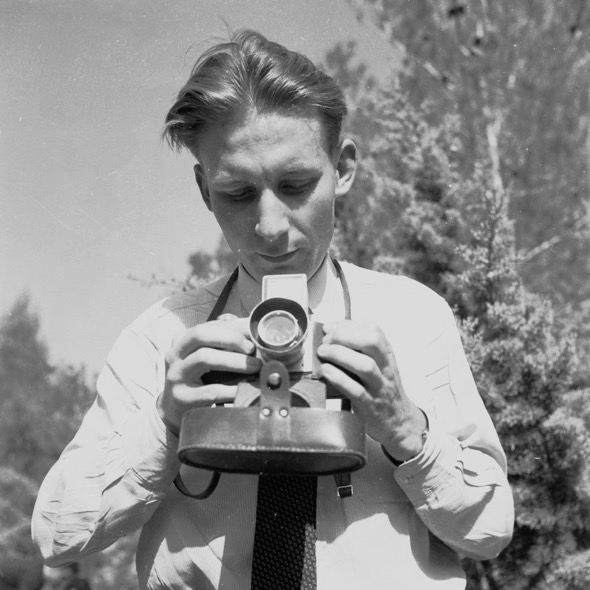
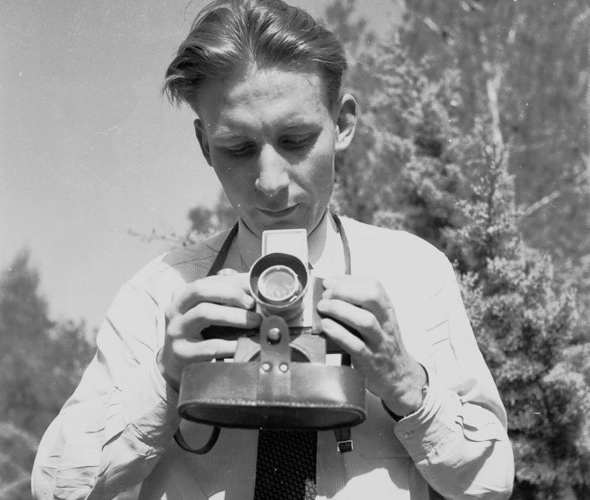
The Swiss photographer Jean Mohr, who died in November 2018 at the age of 93, is well known for his long career documenting the plight of the displaced and dispossessed. But his collaborations with major intellectual figures are especially noteworthy for their creative experimentation with the construction of visual narratives, offering more effective, more engaged, and more experiential accounts of complex social realities. For social scientists, then, there is much to learn by examining Mohr’s life and work in greater detail, particularly for those studying processes of migration or zones of conflict. So, in the summer of 2018, I arranged a short trip to Switzerland to meet with him. On a sunny afternoon, I found myself walking up a leafy road—not far from the shores of Lake Geneva—leading toward Mohr’s house. I rang the doorbell, waiting apprehensively, and a young woman opened the door. “Bonjour,” she smiled. “Monsieur Mohr,” I said, “is he here?” The woman directed me around the side of the house, where I entered a small glass conservatory. In the corner, Mohr was sitting quietly in an armchair; he was visibly tired, though his demeanour was gentle and polite, and he appeared pleased to meet me. I sat down opposite him, took out my notebook, and set my dictaphone to record, as we began a sweeping conversation that would touch upon numerous aspects of Mohr’s life and work.
I began by asking Mohr why photographers, including himself, so often seemed attracted to the topic of migration. He took some time to answer. “Well, because it’s something very special in the last century,” he replied. Indeed, though migration has been a central feature of the social life and political economy of Western Europe for possibly hundreds of years (Moch 1995; Castles et al. 2014), its scale has greatly intensified in the last few decades; as Stephen Castles stresses, “international migration has never been as pervasive, or as socioeconomically and politically significant, as it is today” (2014, 317). And, especially since the invention of photography in the mid-nineteenth century, the experience of migration has also been the subject of intense visual scrutiny. When I asked Mohr how he perceived changes in patterns of migration during his lifetime, I sensed a despairing tone in his voice. “It seems that it becomes more and more hard to be accepted, to find work, and to find a place to live in the last 10 or 20 years,” he tells me. Perhaps the responsibility of photographers to engage with issues of migration, then, has only increased.
For Mohr, the topic of migration, along with related problems of acceptance and belonging, is also very personal. Born as Hans-Adolf in Geneva in 1925, he was the third of six children to Elisabeth Lempp and Wolfgang Mohr, both of German nationality. In 1936, as the National Socialist regime was quickly consolidating power in neighbouring Germany, the entire Mohr family applied for Swiss naturalization; in 1939, Mohr became a Swiss citizen and had his name changed to the less conspicuous Jean. And yet, because of his German heritage, he had been forced to endure fierce discrimination throughout his childhood. “At school, I was very often called ‘dirty German,’ amongst other pupils,” he remembers. “To go from my house… to the school, I had very often to change, every day, a new way to go to school and to come back, to avoid this treatment.” Perhaps this helped him to develop a sensitivity to injustice that would later inform his photography? “Yes, probably,” Mohr mused.
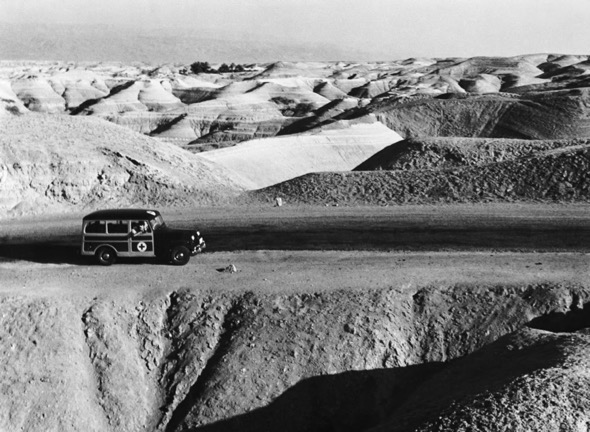
In his mid-twenties, he became a delegate of the International Committee of the Red Cross (ICRC). Initially, Mohr was sent to the Middle East as part of a team acting on behalf of Palestinian refugees; traveling to Beirut, as well as Jericho and Hebron, he took an East German Exakta camera with him so he could take pictures for his father back home. “When my mission in Palestine ended, I returned to Geneva,” he explained, “then I chose to go to Paris and study fine arts.” Having previously studied economics at the University of Geneva, Mohr enrolled in classes at the Académie Julian, a private art school well known for its illustrious alumni, in 1951. Around this time, Mohr was admittedly more interested in painting, recounting even a slight disdain for photography; taking a picture with the mere press of a button and the wind of a lever, he felt, seemed far too easy. It was a conundrum that had once troubled the great Man Ray, writing: “I photograph what I do not wish to paint, and I paint what I cannot photograph” (qtd. in Berger 2013). But photography would eventually win Mohr over, and he returned to Geneva the following year, where he began work as a freelance photojournalist.
He started working for various branches of the United Nations (UN)—the International Labour Organization (ILO), World Health Organization (WHO), and the High Commissioner for Refugees (UNHCR)—documenting their international programs in far-flung countries. The WHO, in particular, had long recognized the importance of photography in publicizing their various projects and engaging with wider audiences; when it launched its glossy World Health magazine in 1959, Joan Bush, a former employee of the Magnum photography collective, was hired as its head photo editor. Yet, Mohr recalls feeling uncomfortable about his work for such organizations: “[H]ere I was, a white photographer,” he says, “sent by the headquarters to any place in Asia or Africa and there was something paternalistic about the whole thing” (1978, 2). Indeed, the history of so-called humanitarian photography, and its strange preoccupation with “the pain of others” (Sontag 2003), is fraught with such ethical problems. “It focuses viewer attention on suffering, framing it as unjust yet amenable to remedy,” note Heide Fehrenbach and Davide Rodogno. Yet, even more problematically, it also “erases distracting political or social detail that would complicate the duty to act” (2015, 6). Nevertheless, in those early humanitarian projects, Mohr was already experimenting with the juxtaposition of text and photography—a decidedly radical style that would come to define his later work.
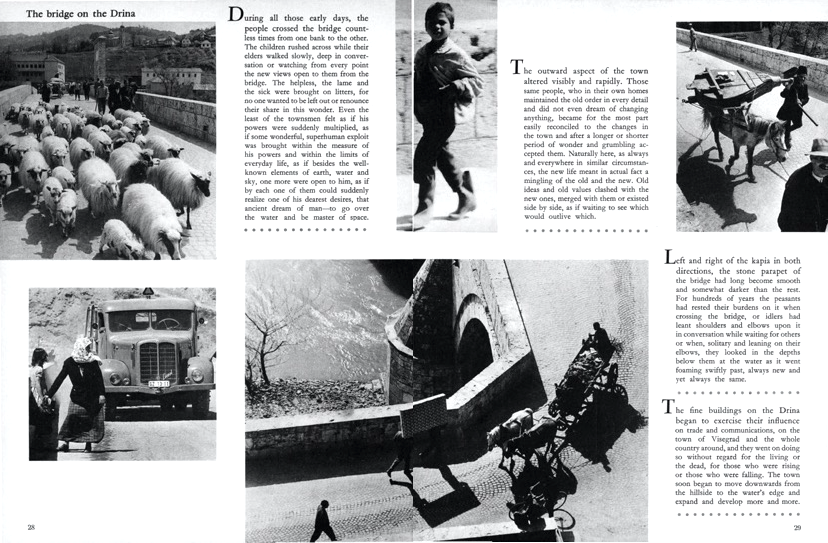
In 1962 the path of Mohr’s career changed drastically when he was introduced to John Berger. Having recently moved to Geneva with his wife, a translator for the UN, Berger had established a reputation in the United Kingdom as an outspoken art critic. A committed Marxist and prolific writer, he had already “stormed the British establishment through the sheer force of his intellect and personality” (Sperling 2018, 46); now, he was in search of a collaborator for a new book project. Having asked his friend, filmmaker Alain Tanner, if he knew any photographers, Berger was put in touch with Mohr. They agreed to meet, marking the start of a friendship and creative collaboration that would last over 50 years, the nature of which the pair would frequently examine. “How should a photographer and writer collaborate?” Berger once pondered. “What are the possible relations between images and text? How can we approach the reader together?” As just one possible answer to such questions, Kelly Klingensmith suggests that “Berger and Mohr’s collaborative works each attempt to convey experience, specifically that of the underprivileged, and through a variety of experimental means.” Their central aim, she suggests, is “to adopt such experience into historical and narrative continuity” (2016, 169).
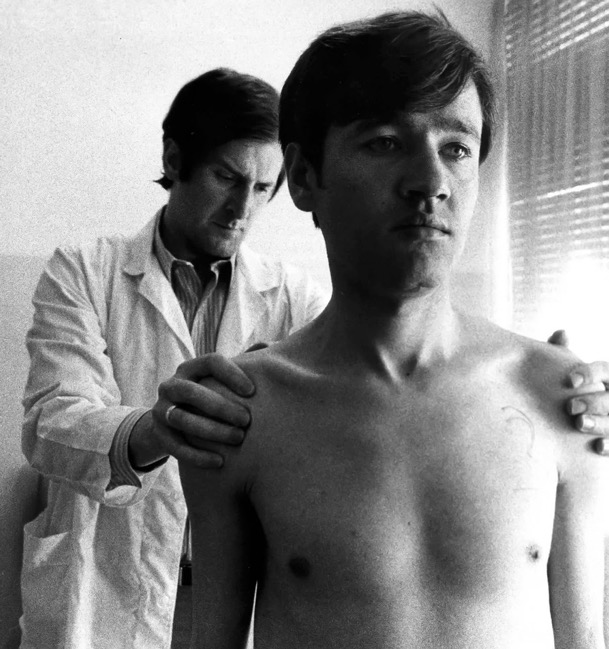
Their first major collaboration began in the summer of 1966, when Mohr and Berger spent six weeks following the life of John Sassall, a country doctor in Gloucestershire, England. While Berger concentrated on writing a poetic account of Sassall’s life and work, Mohr took vivid photographs of his most intimate moments with patients; engrossed in their respective methods of observation, the pair rarely even spoke to one another. Remarkably, upon reviewing their material back in Geneva, they discovered that each had independently tried to produce the book in his own medium. “We found we’d replicated one another’s work entirely,” recalls Berger. “That’s not what we wanted at all, so we reworked it so that the words and pictures were like a conversation; building on, rather than mirroring, one another” (qtd. in Francis 2016). With the help of graphic designer Gerald Cinamon, their work was carefully woven together into a single, creative totality. The result was A Fortunate Man (1967), a book described as having “pioneered the fusion of text and images in photodocumentary” (Francis 2016, 62).
The pair had undoubtedly taken inspiration from Country Doctor, an influential photo essay by American photojournalist W. Eugene Smith. In the summer of 1948, Smith had spent several weeks following the life of Ernest Guy Ceriani, a doctor in rural Colorado; just like Mohr and Berger, he creatively combined text and photography to tell his story. But Mohr and Berger took Smith’s model further, offering a radically new kind of “visual narrative,” one that combined text and photography in a way Berger later described as “simultaneously personal, political, economic, dramatic, everyday and historic” (2013, 56). Since its publication, the book has had an unexpected impact, particularly in the medical community; it has been praised as “the most important book about general practice ever written” (Feder 2005) and is now considered mandatory reading for trainee doctors across the United Kingdom. “I believe it is a classic,” writes Denis Pereira Gray of its enduring pedagogical value, “with a timeless quality which will allow it to help successive generations of general practitioners” (1982, 505).
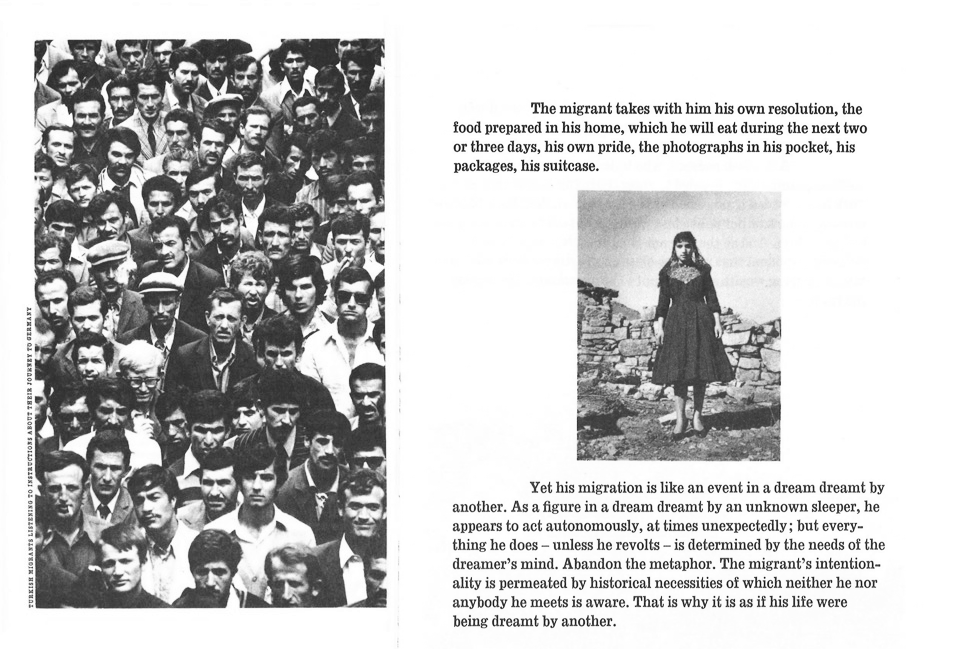
Back in Geneva, my conversation with Mohr turned once again to the topic of migration. In 1973, Mohr and Berger started work on a new project, this time about migrant labour in Europe. After the Second World War, many European countries had sought to attract foreign guest workers to fuel their recovering economies. By the mid-1970s, over 8 million migrants resided in northwestern Europe alone; one in seven manual workers in the United Kingdom and one in four industrial workers in Belgium, France, and Switzerland were then of foreign origin (Moch 2003, 177). Those gastarbeiters, as they were known in Germany, were initially expected to return to their home countries and were granted few legal rights, compounding their already marginalized socioeconomic status (Boyle et. al. 1998). The book Mohr and Berger produced, A Seventh Man (1975), again combined text and photography to document the migrant experience and examine its material circumstances. It was, as Berger writes, “a little book of life stories, a sequence of lived moments,” allowing us to “grasp more surely the political reality of the world” (2010, 8).
I asked Mohr how he had approached the project. “I felt it was very important to say exactly where the migrant worker was coming from, how they crossed the borders and then tried to find the proper way to be accepted and to work,” he explained. Was he involved in composing the text that accompanied his photos? “No, I didn’t feel that I was able to really write about these people,” he replied, “especially because John was a real writer and I just wrote captions. But I felt that I could feel what they were feeling.” That capacity for empathy, his ability to develop such seemingly intimate and meaningful, however fleeting, relationships with his subjects, palpably comes across in many of Mohr’s photographs; as Geoff Dyer suggests, “it is as if the photographs are not taken by Mohr but given by his subjects” (1986, 117). So, I was surprised to learn that, most of the time, Mohr and the people he photographed did not even share a common language. I asked if he felt this limited his interaction with them. “Probably my attitude was more important,” he clarified. “They understood that I was quite sensitive to their situation, so they could trust me.”
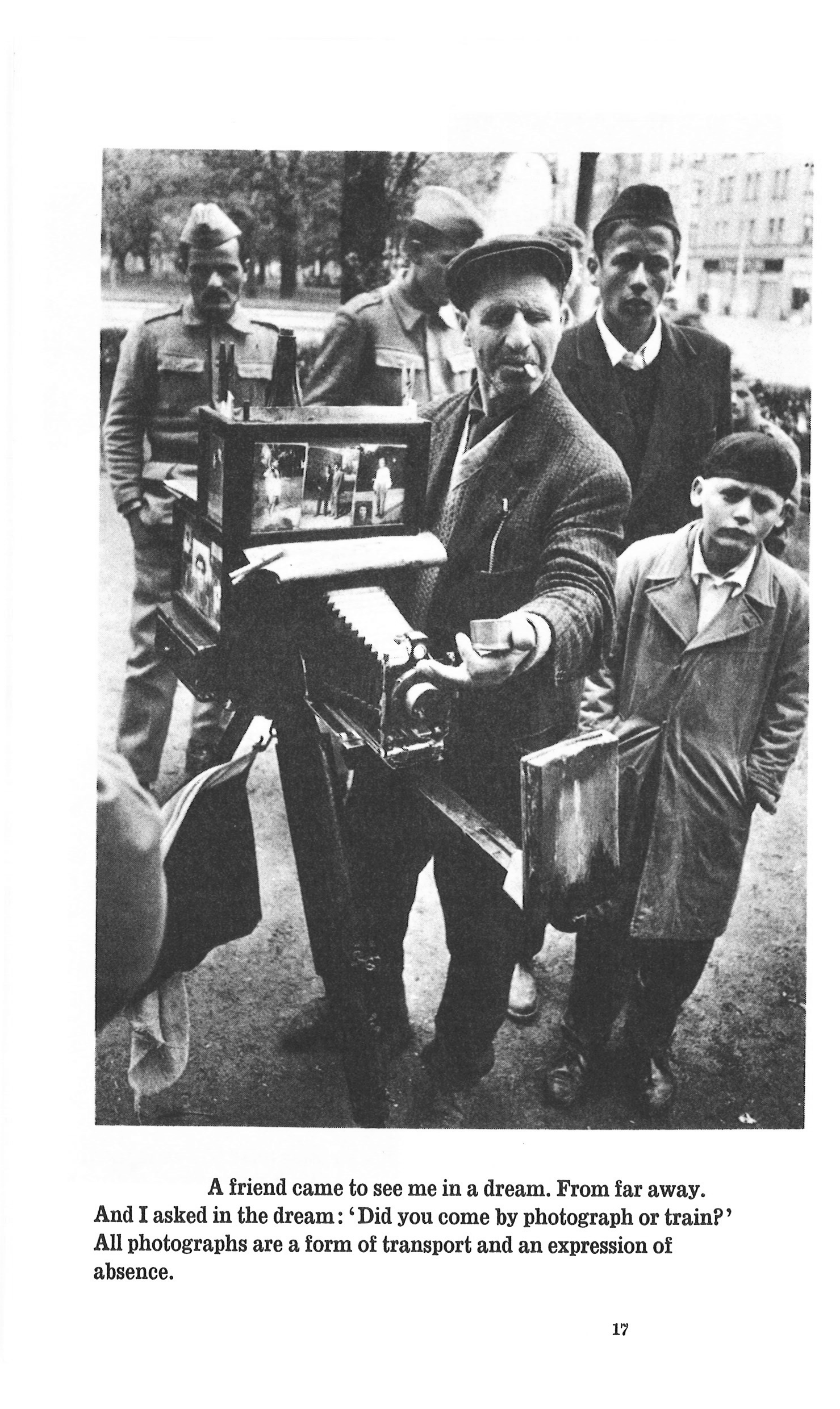
Initially, the pair had intended to make a film. But, due to insufficient funding, they instead settled on producing this “book of moments,” arranging fragments of Berger’s text and Mohr’s photography into three carefully composed chapters that, in many ways, resembled film sequences. Unlike a film, however, the viewer is not constrained by the linear passage of time. “The reader is free to make his own way through these images,” Berger tells us, a practice much like recalling a memory, triggering a succession of others, irrespective of hierarchy, chronology, or duration (2013, 101). As Howard Becker explains, “by selecting the connections to be made from the very many that could be made between the images in any sequence of richly detailed photographs, the viewer constructs the meanings that form the experience of the work” (2002, 5). Thus, the narrative is assembled in the mind of each reader, linking the past with the present, objective reality with subjective experience, one physical space with another, and the book can now acquire a new “living context” of its own. In so doing, A Seventh Man powerfully demonstrates how visual narratives may help in not only documenting the migrant experience but actually reconstituting it across spatial and temporal boundaries—a form of “migratory aesthetics,” perhaps, serving as “both product and critique of a migratory world” (Durrant and Lord 2007, 13).
Following A Seventh Man, Mohr and Berger sought to explore the storytelling potential of photography in closer detail. Their next book, Another Way of Telling (1989), is a collection of stories, reflections, and photographs, loosely organised around the subject of mountain peasants in rural France. But it is also a complex and theoretically sophisticated book about photography itself. “Everyone in the world is now familiar with photographs and cameras,” write Mohr and Berger. “And yet, what is a photograph? What do photographs mean? How can they be used?” In attempting to answer such questions, the pair tackle a number of notoriously tricky issues in photographic theory: among them, the ambiguity of photographs, their relationship to the past, and their ability to disclose, or obscure, some notion of “truth.” In one notable passage, Mohr even contemplates the reasons why a photographer might choose not to take a picture at all: fear, perhaps, or ethical hesitation? Sometimes, he writes, it is so that the experience can be “indelibly printed, not on film, but in my memory” (1989, 79).
In his discussion of the book, Edward Said reflects upon its theoretical, as well as political, significance. Much like A Seventh Man, he argues, Another Way of Telling is a brilliant experiment in form, an attempt at pushing the creative boundaries of what combinations of text and photography can do. But in it, he also detects an implicit, if not yet fully formed, argument for an altogether new type of visual narrative. “At the heart of the book is, I think, an argument against linear sequence—that is, sequence construed by Berger as the symbol of dehumanizing political processes,” writes Said (2000, 150). If linear sequence is understood as part of a broader ideological strategy for enforcing particular “ways of seeing” (Berger 1972), then to deliberately subvert it is, no doubt, an overtly political act. As such, through the construction of such “counternarratives,” or those that directly oppose or subvert conventional, hegemonic ways of understanding the world, Mohr and Berger demanded revolutionary change, the potential consequences of which went far beyond the pages of their book. “Berger calls this an alternative use of photography,” writes Said, “using photomontage to tell other stories than the official sequential or ideological ones produced by institutions of power” (2000, 146).
Impressed by Mohr’s work, Said decided to get in touch. In 1983, while serving as a consultant to the UN for its International Conference on the Question of Palestine, he recommended that photographs by Mohr be hung in the entrance hall of the Palais des Nations, where the conference was held in Geneva. His proposal was approved, and Mohr soon left on a special UN-sponsored mission to the Palestinian territories. For Mohr, this was the continuation of a lifelong concern with the plight of the Palestinian people; he had first visited Palestine on assignment for the ICRC in 1949, just a year after Israel’s proclamation of independence. In the immediate aftermath, an estimated 700,000 Palestinians had been forcibly expelled from their homes; today, the UN records over five million Palestinian refugees spread across the Middle East region alone. As Mohr surely recognised, the history of Israeli-Palestinian relations is deeply entangled with the politics of vision and visuality. The “oppressive relationship between the Israeli occupiers and the Palestinian occupied,” Gil Hochberg writes, “is articulated through and manifested in [the] uneven distribution of ‘visual rights’” (2015, 3). So, as a photographer, Mohr had an important role to play.
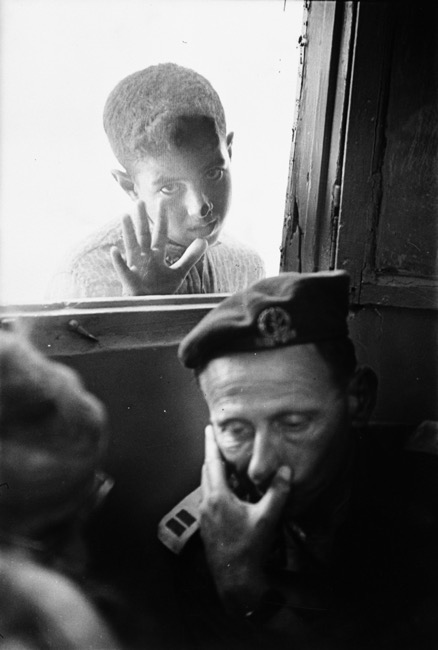
But, upon completing his trip to Palestine, the UN’s response was unexpected. Oddly, Mohr was forbidden to attach any words to his photographs, with the exception of a name or the place represented. This peculiar constraint, perhaps meant to limit the impact of the photos by preserving their ambiguity, was particularly ironic for Mohr. It conflicted directly with his enduring interest in exploring, along with collaborators such as Berger or Said, the complex relationship between text and image. “I often feel the need to explain my photos, to tell their story,” wrote Mohr in Another Way of Telling. “Only occasionally is an image self-sufficient” (1989, 42). A similar sentiment was expressed by Walter Benjamin, troubled by the fact that the camera could transform even a rubbish heap into an object of aesthetic beauty. He believed words could not only help resolve the problem but would radically transform the social function of the photograph. “What we must demand from the photographer,” wrote Benjamin, “is the ability to put such a caption beneath his picture as will rescue it from the ravages of modishness and confer upon it a revolutionary use value” (2003, 95). While Mohr certainly recognized this dilemma, he nevertheless agreed to the UN’s arcane terms, and the photographs were exhibited with minimal written explanation.
Despite this hurdle, Mohr’s photographs were a success, and Said found them deeply moving. “Many Palestinian friends who saw Jean Mohr’s pictures thought that he saw us as no one else has,” he wrote. “But we also felt that he saw us as we would have seen ourselves—at once inside and outside our world” (1999, 6). Indeed, Mohr’s photographs seemed to acknowledge, or even underscore, the tensions between insider and outsider, fiction and reality, photographer and subject; a kind of “double vision,” as Said succinctly put it, that suitably reflected the Palestinian experience of exile and estrangement. “Most people are principally aware of one culture, one setting, one home; exiles are aware of at least two,” he wrote, “and this plurality of vision gives rise to an awareness of simultaneous dimensions, an awareness that—to borrow a phrase from music—is contrapuntal” (2000, 186). In a similar way, writes Krista Kauffmann, Mohr’s photographs embody a kind of “self-conscious vision that always also critiques its own conditions of viewing” (2012, 94), an attitude that clearly came across as Mohr thoughtfully reflected on his life and work.
The photographs displayed at the Palais des Nations, in addition to Mohr’s work from previous trips to Palestine, would later form the basis for a more sustained collaboration with Said. “The whole history of the Palestinian struggle,” Said was convinced, “has to do with the desire to be visible” (2006, 2). Alternative visions of Palestinian life, he reasoned, were urgently needed; ones that could offer more nuanced and historical understandings of a complex political situation and a misrepresented people. On the so-called “question of Palestine,” Said had described his approach as having been “grounded in a sense of human rights and the contradictions of social experience, couched as much as possible in the language of everyday reality” (1980, xv)—perhaps also a fitting description of Mohr’s work as a photographer. And so, it was no surprise that he initiated a new project with Mohr: an experimental book that, like the Berger collaborations, would combine words and images in a radically new way, constructing an alternative narrative of Palestinian life. “Let us use photographs and text, we said to each other,” recalled Said, “to say something that hasn’t been said about Palestinians” (1999, 4).
When Said visited Mohr’s home in Geneva, he found an enormous archive of over eight thousand photographs from Palestine dating back to 1949. He spent several weeks carefully making his selection; spreading photographs across the floor, he grouped them into series, then into four thematic groups, and finally arranged them into individual page layouts. It was a remarkably abstract process, recalled Said, comparable to making music. Indeed, as Gerry Badger suggests, “it is useful to think of musical qualities like point and counterpoint, harmony and contrast, exposition and repeat” when assembling photographic sequences, particularly as they “are more abstract in actuality than they might appear, even when the photography is ‘documentary’ in nature” (2014, 18). So, as Said composed his symphony of photography and text, he was guided more by his feelings than by any conventional narrative logic. “What I have quite consciously designed… is an alternative mode of expression to the one usually encountered in the media, in works of social science, in popular fiction,” he wrote. “It is a personal rendering of the Palestinians as a dispersed national community—acting, acted upon, proud, tender, miserable, funny, indomitable, ironic, paranoid, defensive, assertive, attractive, compelling” (1999, 6).
Published in 1986, After the Last Sky was described by Salman Rushdie as “a very personal text, and a very moving one, about an internal struggle: the anguish of living with displacement, with exile” (1986, 11). As Mohr’s poignant photographs and Said’s lyrical text intermingle across the book’s pages, they reveal the realities of Palestinian life in a way that few have done before. But at the same time, the book offers much more than a simple portrait of the Palestinian people: it demands from the viewer a deeper and more profound engagement with the politics of seeing. “We do more than stand passively in front of whoever, for whatever reason, has wanted to look at us,” writes Said. “We are also looking at our observers” (1999, 166). Like A Seventh Man, the book seems to acquire a “living context,” as the viewer becomes an active participant in the construction of the Palestinian narrative. But here, After the Last Sky goes a step further: there is often an uncanny sense that, through the combination of Mohr’s photographs and Said’s text, the Palestinian people acquire a political agency that holds the viewer themselves accountable. And for that reason, After the Last Sky remains, to this day, a powerful reflection on the struggles and contradictions of Palestinian life.
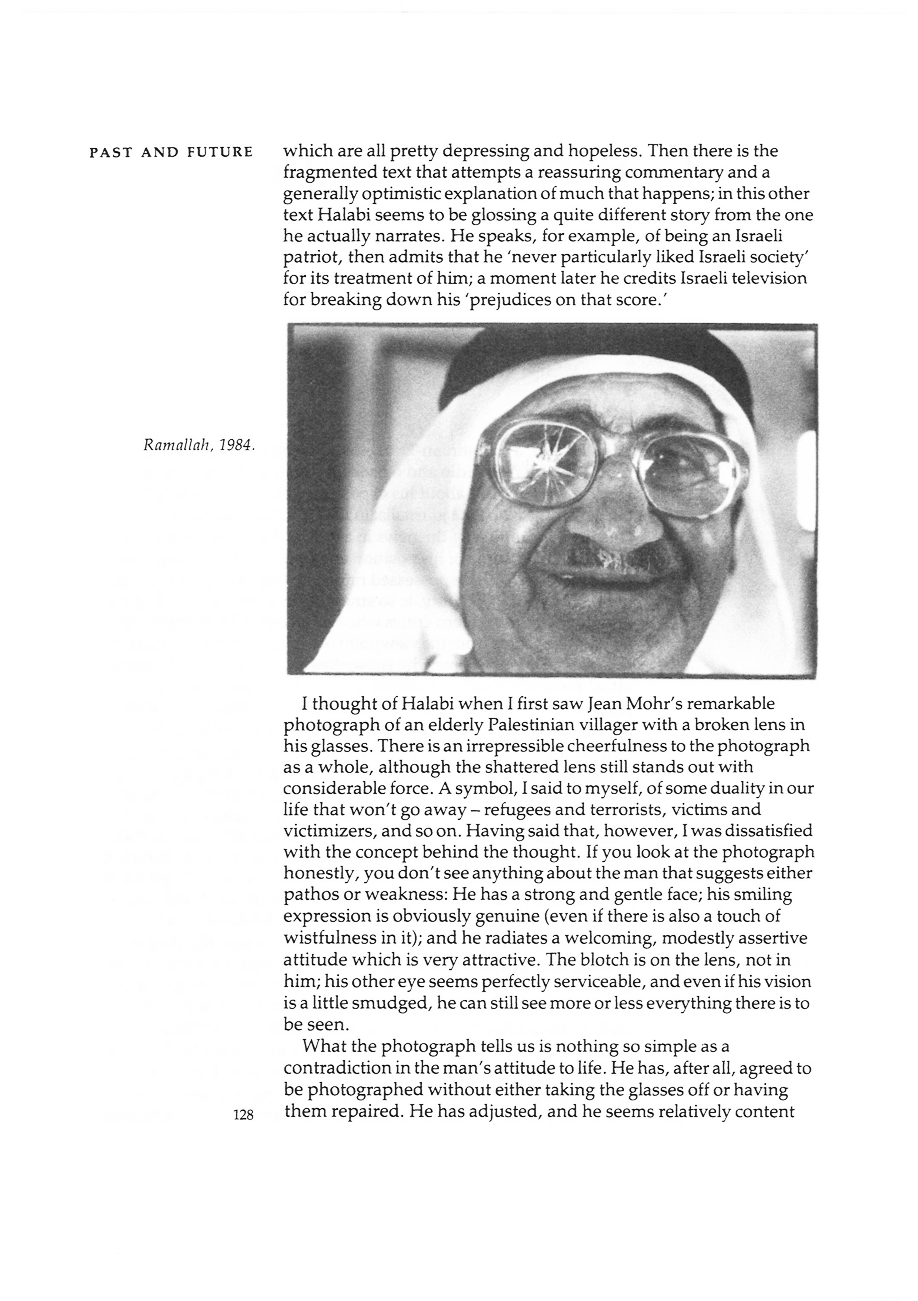
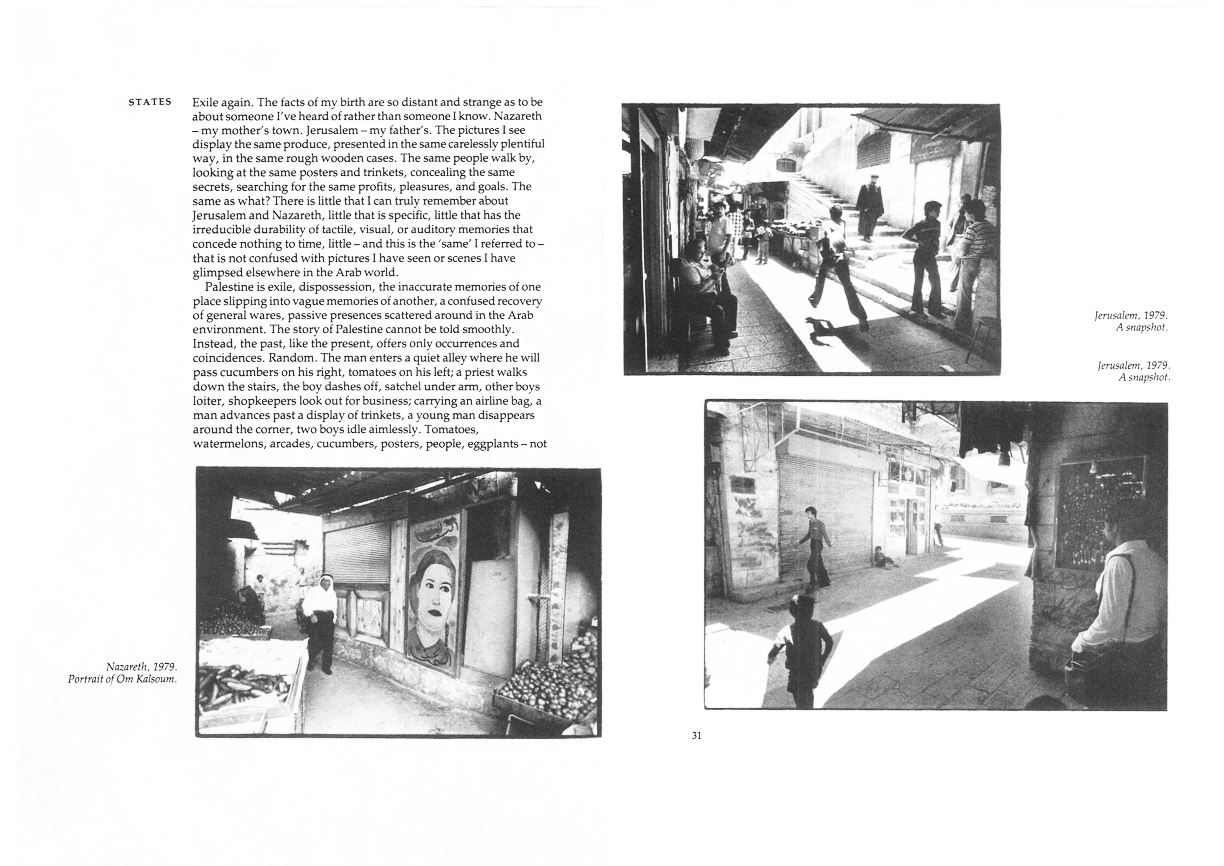
I asked Mohr to tell me more about his other projects in the years since his collaboration with Said. Despite his advancing age and a bout of health problems, he continued working diligently with international organisations, as well as developing new artistic projects closer to home (notably, he spent years photographing the Orchestre de la Suisse Romande). In 1988, he received the prize of the City of Geneva for the visual arts—the first time it was awarded to a photographer—and, more recently, several major exhibitions have offered important retrospectives of Mohr’s work. In 2003, Side by Side or Face to Face, an exhibition of 70 photographs from Israel and the Palestinian territories, went on show in Geneva and other selected cities—including Jerusalem, Gaza, and Ramallah. And in 2013, to help mark the 150th anniversary of the founding of the ICRC and the signing of First Geneva Convention, War from the Victims’ Perspective went on show in more than 40 cities. Organized into four sections—“Portraits of Exile,” “Temporary Landscapes,” “The Children’s Diaspora,” and “Life Goes On”—it chronicled the everyday experience of living through conflict in a presentational style unmistakably reminiscent of Mohr’s collaborations with Berger and Said.
Today, Mohr’s work may be more pertinent than ever. His photographs of John Sassall, the country doctor whose dedication to his patients was infallible, are now even more poignant, as neoliberal reforms have slowly eroded Britain’s National Health Service (NHS). The relevance of A Seventh Man has only increased, as over 150 million migrant workers are now employed around the world, and European attitudes toward immigration have turned increasingly xenophobic (Baumgartl and Favell 1995). And, as the “question of Palestine” remains unanswered, Mohr’s photographs still offer a powerful critique of the nature of exile and the role images can play in the face of political oppression. Above all, Mohr demonstrated how carefully considered combinations of text and photography could be used to construct sophisticated visual narratives that are at once poetic, socially engaged, and politically arresting. For social scientists, particularly those studying processes of migration or zones of conflict, his work shows how such narratives might offer more effective and more engaged accounts of complex social realities, ones that might, as Luc Pauwels puts it, “[express] insights in novel, more experimental and experiential ways” (2015, 315).
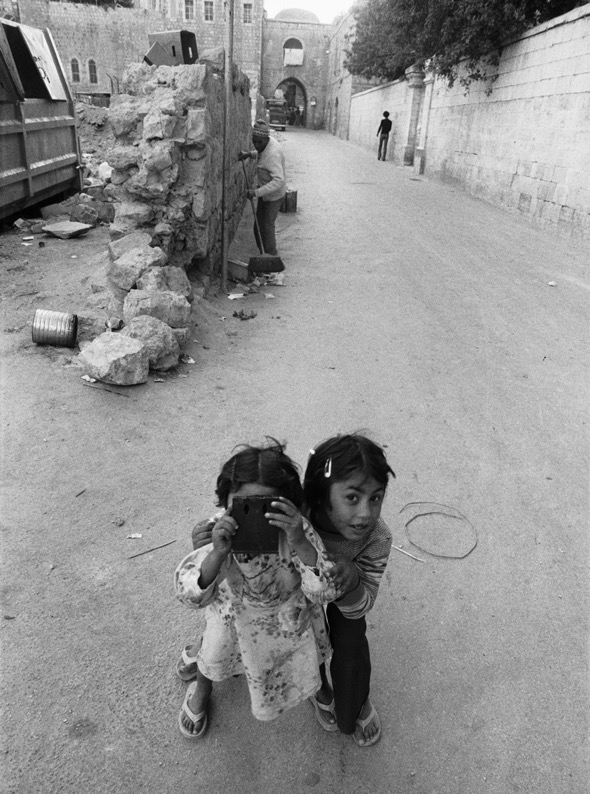
Back in Geneva, my conversation with Mohr had now come to an end. I put down my notebook and stopped the dictaphone recording. Then, to my surprise, Mohr got out a selection of his photographs to show me; just a few of the hundreds of thousands he had taken during his lifetime (his complete archives were donated in 2009 to the Musée de l’Elysée in Lausanne). There were photos from Romania in 1961, Uzbekistan in 1966, India in 1977; from Cambodia, Algeria, Sri Lanka, and even Lapland. But one in particular caught my eye: in 1979, while in Jerusalem, Mohr had encountered two young children playing in the street. Holding up a used Polaroid film pack as if it were a camera, they mimicked Mohr, pretending to take his picture. He, in turn, took theirs. It was a moment that seemed to symbolise Mohr’s unique approach to photography: his ability to capture his subjects with complexity, sensitivity, and even a little humour. “A photograph,” John Berger once wrote, “is a meeting place where the interests of the photographer, the photographed, the viewer and those who are using the photograph are often contradictory” (Berger and Mohr 1989, 7). And throughout his life, Mohr had helped confront those contradictions, leaving behind an indelible legacy that we—as both photographers and the photographed—can surely all benefit from.
Works Cited
Badger, Gerry. “It’s All Fiction: Narrative and the Photobook”. Imprint: Visual Narratives and Beyond edited by G. Knape et al., Stockholm: Art and Theory Publishing, 2014, pp. 15-47.
Baumgartl, Bernd, and Adrian Favell. New Xenophobia in Europe. London: Kluwer Law International, 1995.
Becker, Howard. “Visual evidence: A Seventh Man, the Specified Generalization, and the Work of the Reader.” Visual Studies, 17:1, 2002, pp. 3-11.
Benjamin, Walter. Understanding Brecht. London: Verso, 2003.
Berger, John. Understanding a Photograph. London: Penguin, 2013.
Berger, John. Ways of Seeing. London: BBC/Penguin, 1972.
Boyle, Paul, Keith Halfacree, and Vaughan Robinson. Exploring Contemporary Migration. Essex: Pearson Education Limited, 1998.
Castles, Stephen, Hein de Haas, and Mark Miller. The Age of Migration: International Population Movements in the Modern World. Baskingstoke: Palgrave Macmillan, 2014.
Durrant, Sam, and Catherine Lord. Essays in Migratory Aesthetics: Cultural Practices Between Migration and Art-making. New York: Rodopi, 2007.
Dyer, Geoff. Ways of Telling: The Work of John Berger. London: Pluto, 1986.
Feder, Gene. “A Fortunate Man: Still the Most Important Book about General Practice Ever Written.” British Journal of General Practice vol. 55, no. 512, 2005, pp. 246-247.
Fehrenbach, Heide and Davide Rodogno. “Introduction.” Humanitarian Photography: A History, edited by H. Fehrenbach and D. Rodogno, New York: Cambridge University Press, pp. 1-21.
Francis, Gavin. “Blood”. A Jar of Wild Flowers: Essays in Celebration of John Berger. London: Zed, 2016.
Gray, Denis Pereira. “Berger and Mohr’s A Fortunate Man”. The Journal of the Royal College of General Practitioners vol. 32, no. 241, 1982, pp. 505-506.
Hochberg, Gil. Visual Occupations: Violence and Visibility in a Conflict Zone. Durham: Duke University Press, 2015.
Kauffmann, Krista. “‘Double Vision’: Visual Practice and the Politics of Representation in Edward W. Said and Jean Mohr’s After the Last Sky”. ARIEL vol. 43, no. 3, 2012, pp. 93-122.
Klingensmith, Kelly. In Appropriate Distance: The Ethics of the Photographic Essay. Albuquerque: University of New Mexico Press, 2016.
Moch, Leslie Page. Moving Europeans: Migration in Western Europe since 1650. Bloomington: Indiana University Press, 2003.
Mohr, Jean, and Edward Said. After the Last Sky: Palestinian Lives. New York: Columbia University Press, 1999.
Mohr, Jean, and John Berger. Another Way of Telling. Cambridge: Granta Books, 1989.
Mohr, Jean, and John Berger. A Fortunate Man: The Story of a Country Doctor. New York: Vintage, 1967.
Mohr, Jean, and John Berger. “The Authentic Image: An Interview with John Berger and Jean Mohr”. Representation and Photography: A Screen Education Reader edited by M. Alvarado, E. Buscombe and R. Collins. New York: Palgrave, 2001.
Mohr, Jean, and John Berger. A Seventh Man. London: Verso, 1975.
Mohr, Jean. “Jean Mohr: Ways of Working.” Interview by Shirley Read and Tom Picton. Camerawork, 10, 2, 1978.
Pauwels, Luc. Reframing Visual Social Science: Towards a More Visual Sociology and Anthropology. Cambridge: Cambridge University Press, 2015.
Rushdie, Salman. “If I forget thee…” The Guardian, 19 September, 1986, p. 11.
Said, Edward. “Preface.” Dreams of a Nation: On Palestinian Cinema, edited by H. Dabashi. New York: Verso, 2006.
Said, Edward. Reflections on Exile and Other Essays. Cambridge, MA: Harvard University Press, 2000.
Said, Edward. “Opponents, Audiences, Constituencies, and Community.” Critical Inquiry, vol. 9, no. 1, 1982, pp. 1-26.
Said, Edward. The Question of Palestine. New York: Vintage, 1980.
Sontag, Susan. Regarding the pain of others. New York: Picador, 2003.
Sperling, Joshua. A Writer of Our Time: The Life and Work of John Berger. London: Verso, 2018.